
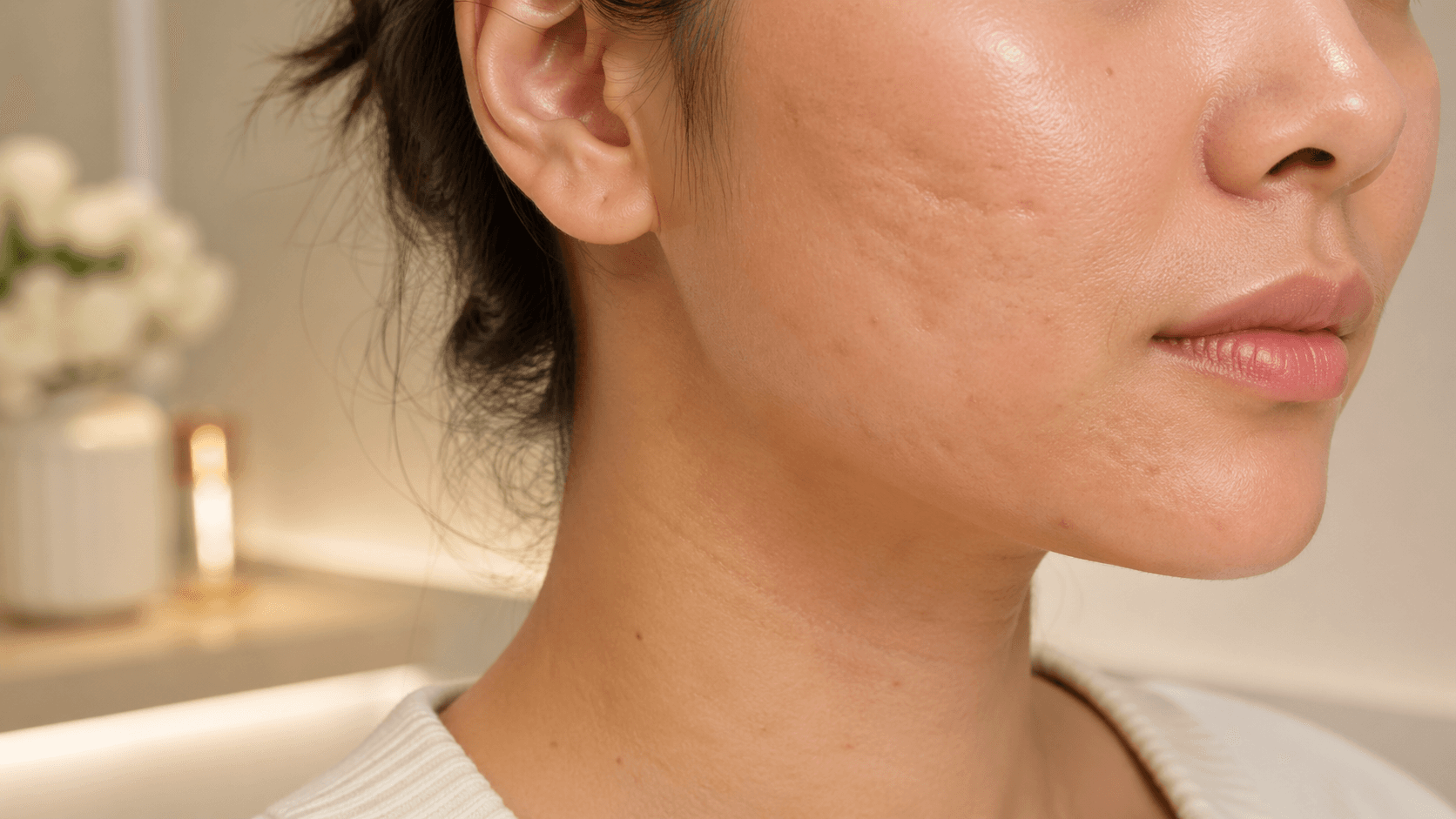
Does microneedling work for acne scars? Full breakdown
If you are searching does microneedling work for acne scars, the short answer is: yes, it can improve the appearance of facial acne scars, but it is not the right answer for every scar type and it usually takes more than one session.[1][2][3]
The most useful way to think about microneedling is not as a miracle fix, but as a collagen-stimulating treatment that can help certain atrophic acne scars look smoother and less obvious over time.[2][3] The FDA states that legally authorized microneedling devices are intended to improve the appearance of facial acne scars in adults aged 22 years or older.[1][4]
What matters most is which type of scar you have, whether your skin is currently calm enough to treat safely, and whether microneedling is being used on its own or as part of a broader acne-scar plan.[3][5]
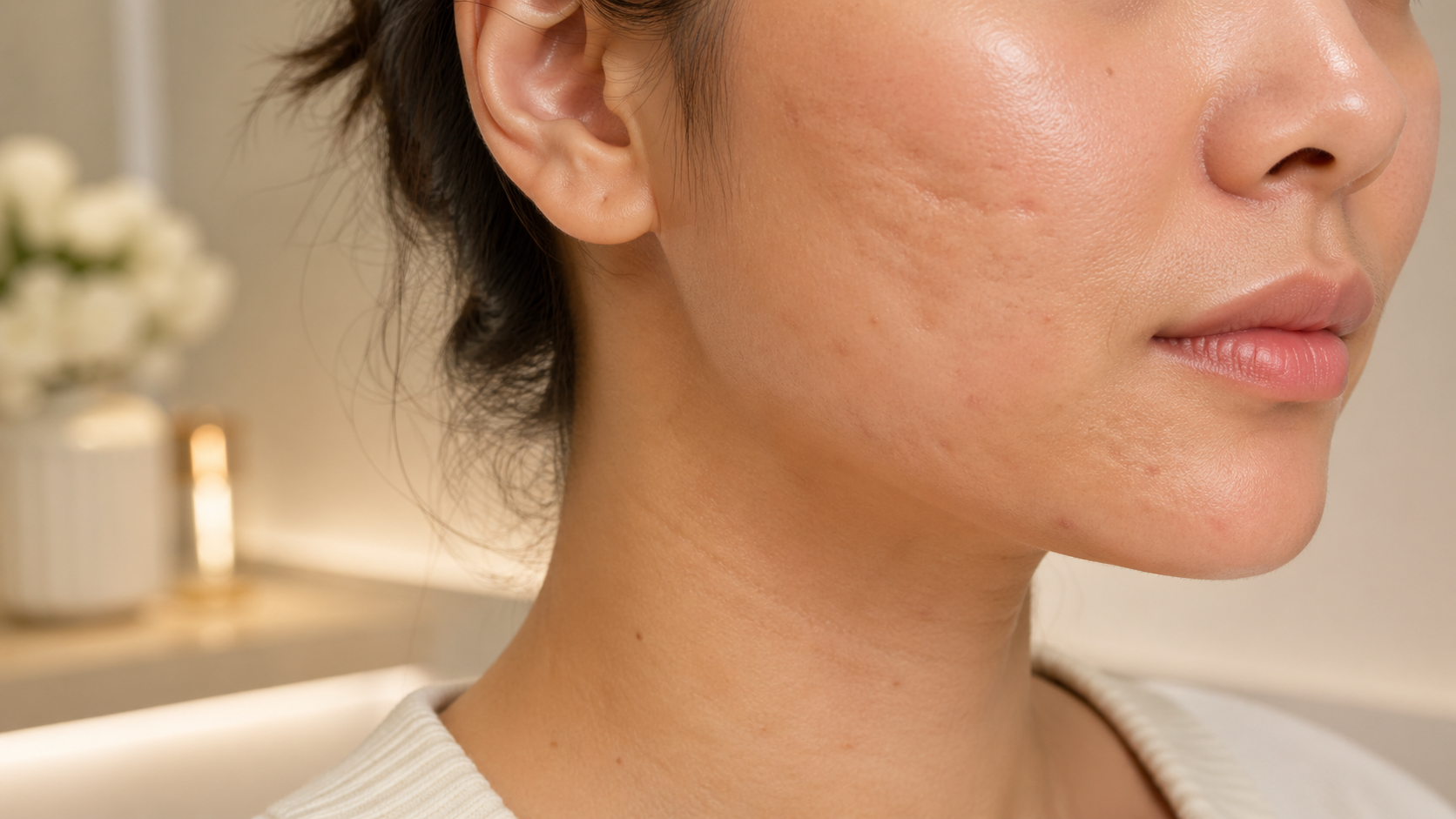
This guide breaks down what microneedling can realistically do for acne scars, where it tends to work best, where it falls short, and how to think about booking from a consultation-led perspective.
Table of contents
- Quick answer: does microneedling work for acne scars
- What microneedling actually does
- Which acne scars respond best
- What microneedling does not fix well
- How many sessions people usually need
- When results start showing
- Risks, downtime, and skin-of-colour considerations
- When you may need more than microneedling
- FAQ
- Booking and next steps
Quick answer: does microneedling work for acne scars
Yes, microneedling can improve acne-scar appearance, and the strongest support is for atrophic facial acne scars rather than raised scars or simple post-acne marks.[1][3][5]
Here is the evidence-based version:
- The FDA has legally authorized microneedling devices to improve the appearance of facial acne scars.[1]
- A 2020 systematic review found that all 33 included studies reported improvement in acne-scar appearance after microneedling, although the review also said evidence was still inconsistent when comparing microneedling alone with laser or combination treatments.[3]
- The American Academy of Dermatology (AAD) says dermatologists use microneedling to diminish acne scars and that the treatment works by stimulating collagen production.[2]
- The FDA also warns that microneedling may not always produce the desired outcome and that more than one procedure may be needed.[4]
So if the question is simply does microneedling work for acne scars, the defensible answer is:
It often helps, especially for selected depressed acne scars, but it is not a one-session cure and it is not equally effective for every scar pattern.
What microneedling actually does
Microneedling works by creating controlled punctures in the skin, which stimulates a wound-healing response and collagen production.[1][2] That is why it is often called collagen induction therapy.[2]
The goal in acne-scar treatment is not to "fill" the scar the way a filler would. The goal is to encourage remodeling in the skin so that the scar edges and surrounding texture gradually look smoother.[2][3]
That distinction matters because it helps set expectations:
- Microneedling can improve texture and scar appearance
- It does not instantly erase a scar
- It does not replace every other acne-scar treatment
This is also why professional treatment matters. The FDA notes that many authorized devices are motorized and penetrate living layers of skin, so the agency recommends treatment by a health care provider with special training in microneedling.[4]
Which acne scars respond best
Acne scars are not all the same. The AAD separates acne scars into different categories, including ice pick scars, rolling scars, boxcar scars, and raised scars such as hypertrophic scars and keloids.[6]
For depressed acne scars:
- Rolling scars are described by AAD as wide and shallow, giving the skin a wavy look.[6]
- Boxcar scars are wider than ice pick scars and appear as round or oval depressions.[6]
- Ice pick scars are small-looking but extend deep into the skin.[6]
Microneedling generally makes the most sense when the goal is to improve atrophic or depressed scar texture.[3][5] In practical terms, that usually means it tends to be more helpful for rolling scars and some boxcar scars than for very deep ice pick scars.[3][5][6]
Why? Because the deeper and narrower the scar, the less likely simple collagen stimulation alone is to fully address the shape of the defect. That is one reason acne-scar treatment often becomes a combination strategy rather than a one-tool plan.[5]
What microneedling does not fix well
Microneedling is often oversold online because people mix up different kinds of post-acne marks.
AAD specifically notes that post-inflammatory hyperpigmentation (PIH) is not a scar.[6] Those flat red, brown, or gray marks that remain after acne can fade over time and may need a different treatment strategy than true scarring.[6]
Microneedling is also not the ideal single solution for:
- Deep ice pick scars[5][6]
- Raised acne scars such as hypertrophic scars or keloids[6]
- Volume loss or tethered scars where another procedure may be needed to release or lift the scar[5]
That does not mean microneedling has no role. It means the role has to be chosen correctly.
How many sessions people usually need
One of the biggest mistakes people make is judging microneedling after a single session.
The FDA says more than one procedure may be needed to get the improvement you want.[1][4] In one FDA device summary for acne-scar clearance, the treatment schedule referenced 3 treatments spaced 4 weeks apart.[7] That is device-specific evidence, not a universal rule, but it supports the general point that acne-scar improvement is usually built over a course, not a single appointment.[7]
That same FDA summary reported that after a treatment course, physician grading showed at least a 1-grade improvement in acne scarring in 70% to 85% of patients, depending on the blinded assessor used in the study.[7]
So the realistic treatment-planning takeaway is:
- Expect a course, not a one-off
- Expect review between sessions
- Expect progress to be gradual
When results start showing
Microneedling can leave skin looking temporarily brighter as healing begins, but acne-scar improvement is usually a slower process because it depends on remodeling, not instant filling.[2][3]
The FDA says that short-term effects such as redness, tightness, itching, and peeling commonly settle over days to weeks, while improvement itself may require multiple procedures and can be temporary over time.[4]
That means the right expectation is:
- Early healing changes happen first
- Texture improvement builds progressively
- Final judgment should be made after an appropriate treatment course, not immediately
I cannot confirm a single universal timeline for every patient because scar type, skin tone, aftercare, and treatment depth all change the pace of visible improvement.
Risks, downtime, and skin-of-colour considerations
Microneedling is often described as minimally invasive, and AAD says it is safe for all skin tones when properly performed.[2] However, the FDA adds an important caution: some authorized devices were not studied in subjects with darker skin types, and pigment changes can occur after treatment.[1]
That is why the safest version of this claim is:
Professional microneedling can be appropriate across skin tones, but darker skin still needs careful protocol design because post-treatment darkening or lightening can happen.[1][2][4]
The FDA lists potential short-term and less common risks including:
- bleeding
- bruising
- redness
- tightness
- itching
- peeling
- dark or light spots on the skin
- cold sore flare-ups
- swollen lymph nodes
- infection[4]
The FDA also says microneedling may not be suitable for everyone, including some people with:
- bleeding or clotting issues
- weakened immune systems
- uncontrolled diabetes
- active skin infections
- active rashes
- current cold sores
- recent isotretinoin use
- a history of keloids in the treatment area[1][4]
This is exactly why an acne-scar consultation should include scar typing, skin assessment, pigmentation risk review, and a discussion of what not to treat yet.
When you may need more than microneedling
AAD says getting the best acne-scar results often requires in-depth knowledge of the skin and an individualized treatment plan.[5] That matters because acne scars are usually mixed, not uniform.[5][6]
In the real world, many patients have:
- some rolling scars
- some boxcar scars
- lingering PIH
- a few deeper scars that need a different approach
That is one reason the 2020 systematic review concluded that while microneedling improves acne-scarring appearance, evidence is still mixed when comparing it with combination therapy or laser treatments.[3]
So if microneedling "doesn't work" for someone, that may not mean microneedling is useless. It may mean:
- the scar type was mismatched
- the expectations were unrealistic
- the course was too short
- the patient needed combination treatment instead of monotherapy
FAQ
Does microneedling work for acne scars on dark skin?
AAD says microneedling is safe for all skin tones when properly performed.[2] The FDA, however, notes that some authorized devices were not studied in darker skin types and that darkening or lightening of the skin can happen afterward.[1] The safest conclusion is that skin of colour needs careful assessment and conservative planning, not copy-paste settings.
Does microneedling work for ice pick scars?
It may help overall texture, but it is usually less convincing as a stand-alone answer for very deep, narrow scars. AAD describes ice pick scars as small but deep.[6] That depth is one reason some patients need other or combined treatments.[5][6]
Is microneedling better for rolling scars or boxcar scars?
It generally makes the most sense for depressed atrophic scars, which includes rolling scars and some boxcar scars.[3][5][6] Exact response varies by depth, tethering, and whether you have mixed scar patterns.
How many microneedling sessions are usually needed for acne scars?
More than one. The FDA says multiple procedures may be needed,[4] and one FDA acne-scar device summary used a course of 3 treatments spaced 4 weeks apart.[7]
Can I use a home roller for acne scars instead?
That is not the same thing. AAD says at-home products lead to less noticeable results than medical microneedling, and they also carry risks such as infection, scarring, and spreading viruses across the skin.[2] The FDA also says it has not authorized any microneedling medical devices for over-the-counter sale.[4]
Does microneedling remove acne scars completely?
I cannot confirm that as a reliable outcome. The evidence supports improvement in appearance, not guaranteed full removal.[1][3][4]
Final take
If your question is does microneedling work for acne scars, the honest answer is:
Yes, it can work well for selected facial acne scars, especially depressed atrophic scars, but it is not equally effective for every scar type and it usually works best as part of a treatment plan rather than a one-session promise.[1][2][3][5][6][7]
That is the strategy that protects both results and trust:
- identify the scar type correctly
- separate PIH from true scarring
- choose the right treatment depth and cadence
- know when microneedling is enough and when it is not
Booking and next steps
If you want a consultation-led answer instead of guessing from social media:
- Compare the treatment page: Facials
- Check pricing and routes into consultation: Pricing
- Ask before you book: Contact Us
Related reads
- Professional Microneedling in Hackney London: Realistic Results, Healing Time and Safety Guide
- Preparing for Your First Chemical Peel
- Exosomes vs PRP Treatment: Which Is Better for Skin Rejuvenation?
Sources and references
- FDA. Microneedling Devices. Updated October 15, 2025. https://www.fda.gov/medical-devices/aesthetic-cosmetic-devices/microneedling-devices
- American Academy of Dermatology. Microneedling can fade scars, uneven skin tone, and more. https://www.aad.org/public/cosmetic/scars-stretch-marks/microneedling-fade-scars
- Mujahid N, Shareef F, Maymone MBC, Vashi NA. Microneedling as a Treatment for Acne Scarring: A Systematic Review. Dermatol Surg. 2020;46(1):86-92. PubMed: https://pubmed.ncbi.nlm.nih.gov/31356435/
- FDA. Microneedling Devices: Getting to the Point on Benefits, Risks and Safety. Content current as of October 15, 2025. https://www.fda.gov/consumers/consumer-updates/microneedling-devices-getting-point-benefits-risks-and-safety
- American Academy of Dermatology. Acne scars: Consultation and treatment. https://www.aad.org/public/diseases/acne/derm-treat/scars/treatment
- American Academy of Dermatology. Acne scars: Signs and symptoms. Last updated December 8, 2023. https://www.aad.org/public/diseases/acne/derm-treat/scars/symptoms
- FDA 510(k) Summary K221070. DP4 Microneedling Device. See acne-scar indication, course spacing, and physician-assessed improvement data. https://www.accessdata.fda.gov/cdrh_docs/pdf22/K221070.pdf