

Profhilo vs skin boosters: what's the real difference?
If you are comparing profhilo vs skin boosters, you are likely asking one key question: Which option will improve skin quality without making me look overtreated?
Both are injectable skin treatments and both are based on hyaluronic acid pathways, but they are not the same treatment and should not be sold as interchangeable.

This guide breaks down the practical differences, who each treatment suits, and how to choose a plan that actually matches your skin goals.
Table of contents
- Quick answer: profhilo vs skin boosters
- What Profhilo is
- What skin boosters are
- Key differences between Profhilo and skin boosters
- Which treatment suits which goal
- Timeline: when results usually appear
- Risks, side effects, and safety checks
- Common mistakes when choosing injectable skincare
- Profhilo vs skin boosters FAQ
- Booking and next steps
Quick answer: Profhilo and skin boosters
At a practical level:
- Profhilo is commonly chosen for overall skin quality support and tissue hydration across broader areas.
- Skin boosters are often used for more targeted hydration and texture support in specific zones.
Both can improve glow and skin feel. The right choice depends on your baseline skin condition, treatment area, and whether your goal is global rejuvenation or local correction.
What Profhilo is
Profhilo is an injectable hyaluronic acid treatment designed around spread and integration through selected injection points.
In clinic conversations, clients usually choose Profhilo when they want:
- overall skin freshness
- improved hydration quality
- softer crepey appearance in mild to moderate cases
- subtle rejuvenation rather than visible volume
Profhilo is not a volumizing filler. Its goal is skin quality support, not structural facial reshaping.
What skin boosters are
Skin boosters are injectable hydration treatments delivered in more localized patterns, often across the face, neck, or under-eye-adjacent zones where appropriate for the selected product.
Clients often choose skin boosters for:
- persistent dullness
- fine dehydration lines
- texture support in focused areas
- skin maintenance plans between other aesthetic treatments
Like Profhilo, skin boosters are not generally designed to create dramatic contour changes. They are usually used to improve skin condition, not add strong projection.
Key differences between Profhilo and skin boosters
When people compare Profhilo and skin boosters, these are the decision points that matter most:
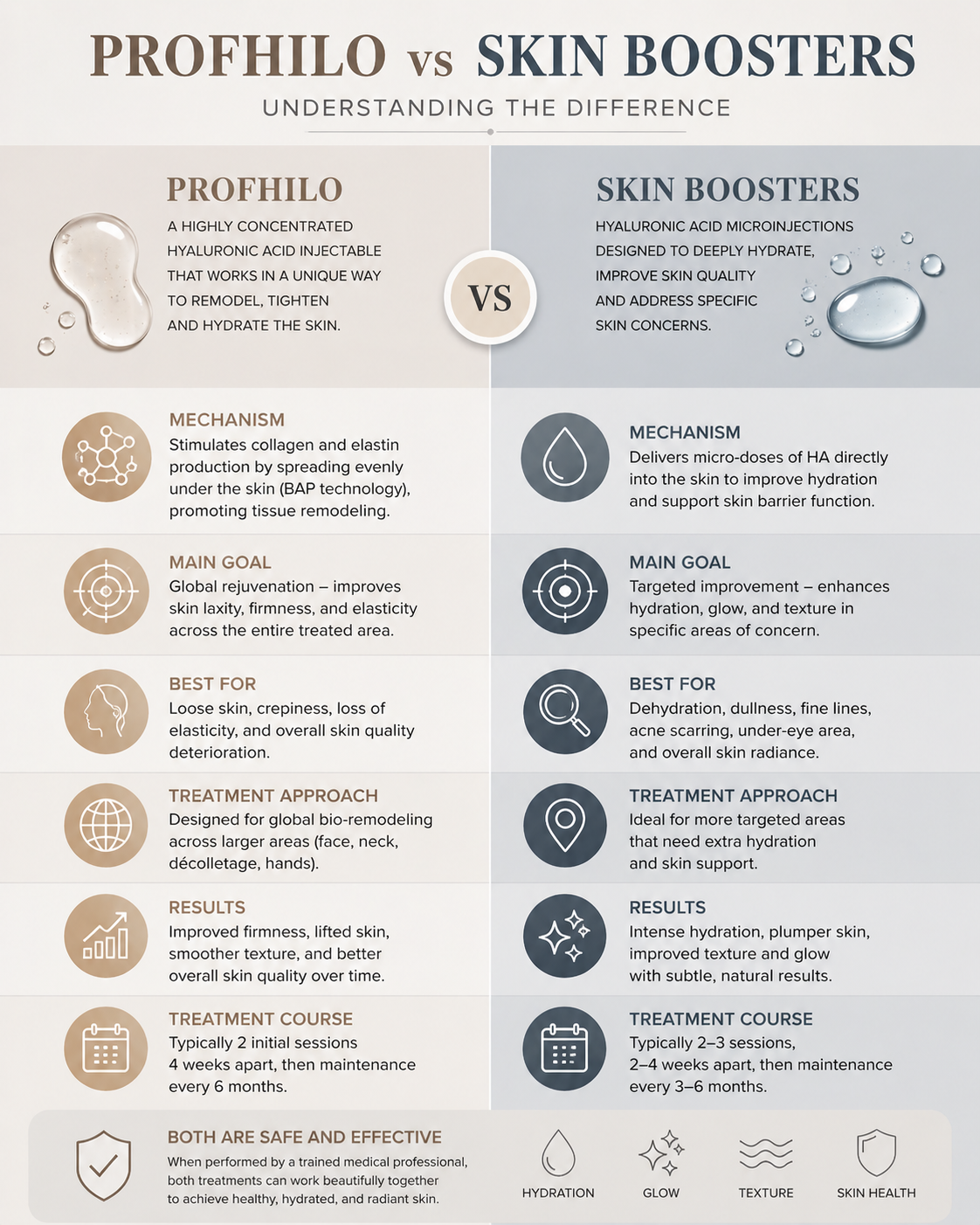
1. Treatment spread pattern
- Profhilo is usually mapped for broader distribution.
- Skin boosters are often delivered in a more targeted grid or focal pattern.
2. Main treatment objective
- Profhilo is typically selected for global skin quality support.
- Skin boosters are often selected for zone-specific hydration and texture refinement.
3. Planning style
- Profhilo plans are often simple and protocol-led.
- Skin booster plans can be more customizable by area, depth approach, and maintenance rhythm.
4. Perceived result style
- Profhilo outcomes are often described as subtle overall freshness.
- Skin booster outcomes are often described as smoother, more hydrated skin in specific areas.
Neither option is objectively "better" in all cases. Appropriateness is what determines good outcomes.
Which treatment suits which goal
Choose Profhilo-first planning if your goal is:
- broad skin quality refresh
- subtle rejuvenation without volume effect
- low-complexity protocol over multiple facial zones
Choose skin booster-first planning if your goal is:
- targeted hydration correction
- fine-line texture support in specific areas
- customized maintenance by area
Consider combination sequencing if:
- you need both global quality support and local refinements
- your skin has mixed concerns (overall dehydration plus localized texture)
- your clinician recommends staged response assessment rather than single-modality loyalty
Timeline: when results usually appear
No injectable skin treatment should be judged too early.
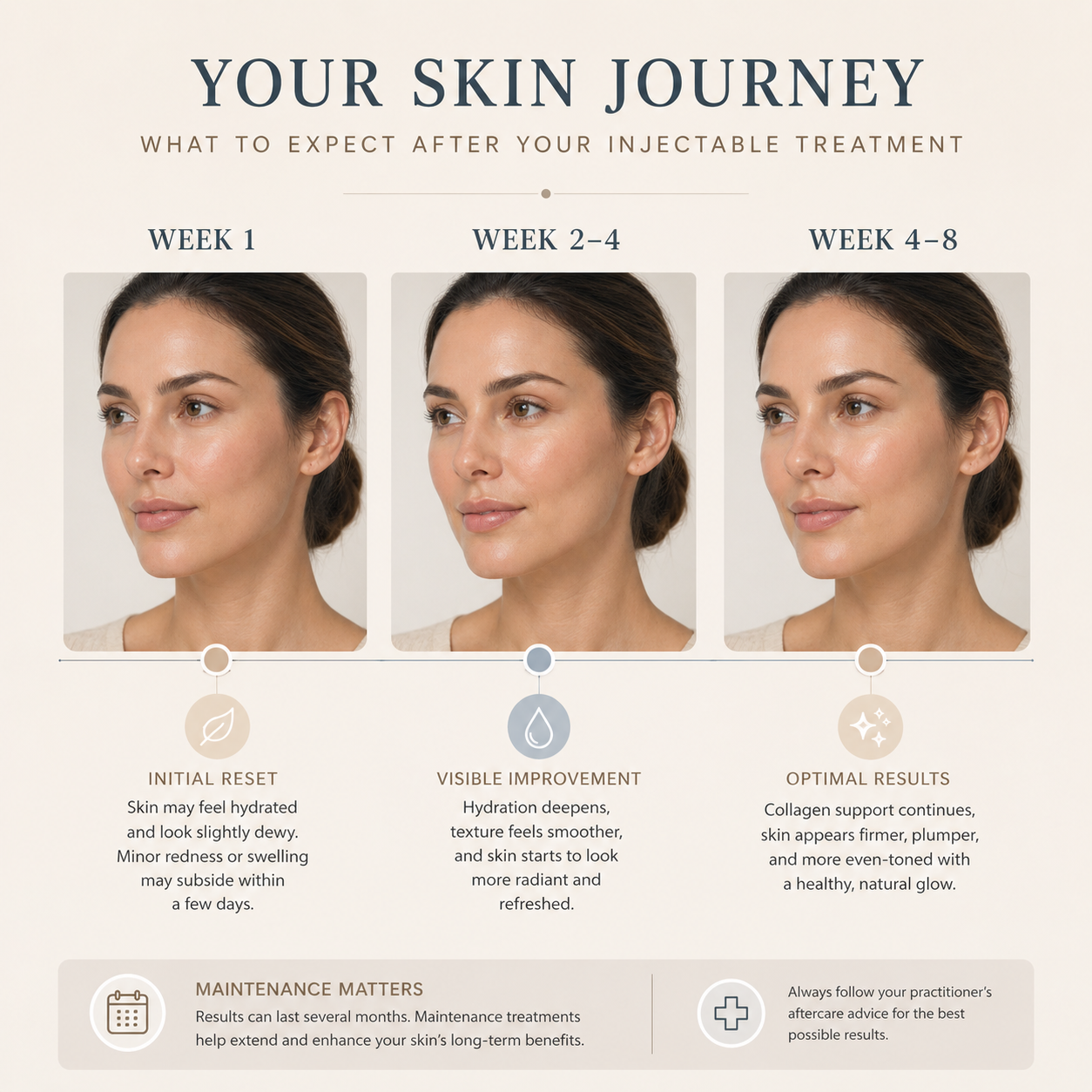
Typical progression for both options is often:
- first 3-7 days: settling phase, possible injection-site visibility
- weeks 2-4: early visible quality shift
- weeks 4-8: clearer textural and hydration changes
Durability varies by product, protocol, baseline skin status, and maintenance behavior.
A strong plan includes review points before deciding on additional sessions.
Cost and maintenance planning (what people forget)
Many clients focus on single-session cost, but long-term value usually depends on maintenance logic.
Before choosing either treatment, ask:
- what the initial course usually looks like
- when reassessment happens
- what signs trigger maintenance versus watchful waiting
- what the realistic annual budget range is for your goals
This avoids two common problems:
- under-budgeting and dropping halfway through protocol
- over-treating too frequently without clear indication
For most skincare-focused clients, consistency beats intensity. A moderate plan that you can maintain usually performs better than aggressive treatment bursts followed by long gaps.
Risks, side effects, and safety checks
Both treatments are generally well tolerated when performed in appropriate clinical settings, but they are still medical procedures.
Common short-term effects may include:
- tenderness
- mild swelling
- bruising
- temporary injection-point visibility
Safety checks should always include:
- medical history review
- contraindication screening
- product selection transparency
- clear aftercare and escalation instructions
If symptoms worsen instead of improving, clinical review is necessary.
Common mistakes when choosing injectable skincare
Mistake 1: choosing by trend, not indication
Social buzz is not a treatment plan. The best option is the one that matches your skin profile.
Mistake 2: expecting filler-like contour change
Profhilo and skin boosters are skin quality treatments, not contour sculpting treatments.
Mistake 3: rushing retreatment
Many people over-treat because they judge too early. Review-led intervals protect natural outcomes and skin tolerance.
Mistake 4: shopping by lowest price only
Cut-price offers can compromise assessment quality and protocol safety. Medical aesthetics should be treated like healthcare decisions, not flash-sale purchases.
Mistake 5: skipping aftercare
Poor aftercare can reduce treatment quality and increase avoidable downtime.
Mistake 6: trying to copy another person's protocol
Even when two people share similar concerns, tissue quality and recovery patterns differ. What worked for someone else may not be optimal for your skin, so protocol copying often leads to disappointing outcomes.
How we decide between Profhilo and skin boosters in clinic
A proper consultation should map:
- your primary complaint (dullness, texture, dehydration, laxity signs)
- area-specific needs (full face vs selected zones)
- expected result intensity (very subtle vs moderate visible improvement)
- lifestyle and maintenance tolerance
Then the clinician should explain:
- why one option is being prioritized
- what realistic improvements to expect
- what timeline is realistic
- when they would pause or change protocol
Good planning is conservative, review-led, and clearly documented.
Profhilo and skin boosters FAQ
Is Profhilo the same as filler?
No. Profhilo is generally positioned for skin quality and hydration support rather than contour volumization.
Are skin boosters better than Profhilo?
Not universally. They can be better for targeted concerns, while Profhilo may be preferred for broader skin-quality goals.
Can I do both Profhilo and skin boosters?
In some cases, yes, with proper sequencing and clinical review. Combination should be indication-led, not automatic.
Which one gives faster glow?
Both can improve skin radiance, but perceived speed depends on baseline skin condition and protocol design.
How many sessions do I need?
There is no one-size-fits-all number. Session planning should be set by assessment and adjusted at review.
Is downtime the same for both?
Not always. Downtime experience depends on product choice, injection pattern, treatment area, and individual healing response.
Can these treatments replace skincare?
No. Injectable skin treatments work best when paired with consistent home skincare and sun protection.
Who should avoid treatment for now?
Anyone with active skin infection, uncontrolled inflammation, or other contraindications identified during consultation should defer treatment until safe.
Final take: choose indication over hype
The right answer is not whichever option is trending. It is whichever option is clinically appropriate for your skin goals and tolerance profile.
If your objective is natural, healthy-looking skin:
- choose assessment first
- choose conservative protocol design
- choose review-led decisions over impulse top-ups
That is usually the fastest path to better results and fewer regrets.
For most people, the strongest outcomes come from realistic planning, not treatment hopping. Pick one evidence-led pathway, follow it consistently, review at the right interval, and only adjust when your response data supports change. That approach protects budget, minimizes overtreatment risk, and keeps results natural over time.
Booking and next steps
If you want guidance on whether Profhilo or skin boosters suit your goals, start with consultation and a structured plan.
- Explore treatment options: Treatment Menu
- Compare booking and pricing: Pricing
- Ask the clinic team first: Contact Us