
How long does botox last? Real timeline + what affects results
If you are searching how long does botox last, you are usually trying to solve two problems at once: smoothing expression lines and keeping your skin looking fresh without overdoing treatment.
The evidence-based short answer is this: for cosmetic glabellar lines, FDA labeling states the effect is approximately 3 to 4 months, with initial effect starting around 1 to 2 days and increasing during the first week.[1] The American Society of Plastic Surgeons (ASPS) also states that many people notice changes within days and full effect may take up to a week, with results typically around 3 to 4 months.[2]
This guide is written for skincare-conscious readers who want realistic expectations, not social media guesswork.
Table of contents
- Quick answer: how long does botox last
- Real Botox timeline (day-by-day and month-by-month)
- What affects how long Botox lasts
- Skincare habits that support better-looking results
- Safety, side effects, and red flags
- Botox FAQ (high-intent questions people search)
- Booking and next steps
Quick answer: how long does botox last
For FDA-approved BOTOX Cosmetic use in glabellar lines:
- Onset: initial effect can begin in 1 to 2 days[1]
- Build phase: effect increases through the first week[1]
- Typical duration: about 3 to 4 months[1][2]
- Retreatment frequency: safety/effectiveness for dosing more often than every 3 months has not been clinically evaluated in the FDA label.[1]
So if your question is simply how long does botox last, the practical planning range for most people is around one quarter, then reassessment.
Real Botox timeline (day-by-day and month-by-month)
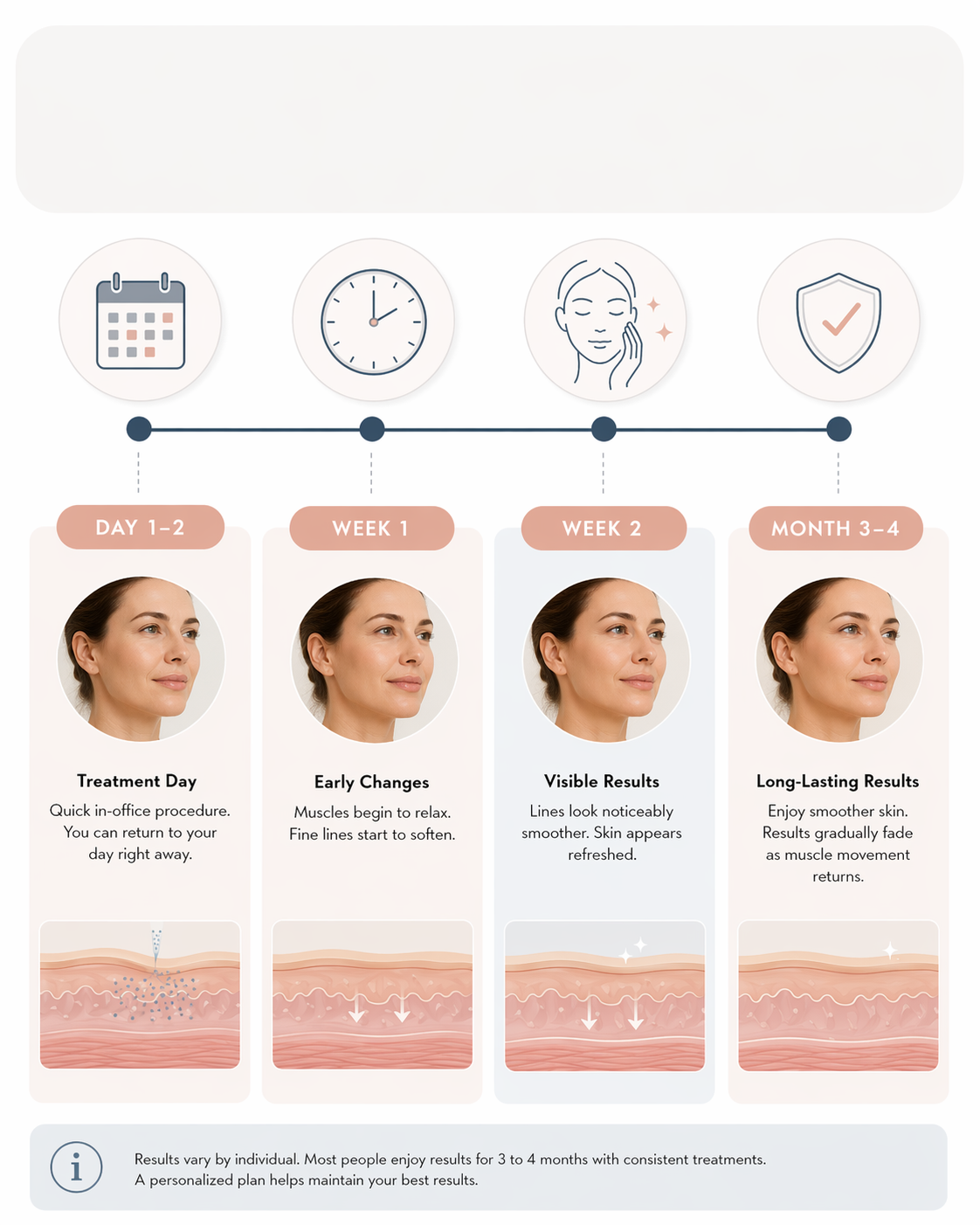
Day 0 to Day 2: treatment done, little visible change yet
Most people do not see final wrinkle change immediately after injections. Early post-treatment appearance can include mild temporary injection-site effects such as redness or tenderness.[1][3]
Day 2 to Day 7: early softening begins
FDA labeling notes that initial effect can begin around 1 to 2 days and increase during the first week.[1] This is the window where many people start seeing softer frown lines or crow's feet.
Day 7 to Day 14: clearer result window
ASPS notes that results may take up to about a week to fully show for many patients.[2] In real practice, this is why clinics often reassess after enough settling time rather than judging at 24 to 48 hours.
Weeks 2 to 8: stable phase
This is usually the period where results look most consistent in photos and mirror checks. Expression lines are typically softer, but individual movement patterns still vary person to person.[2]
Months 3 to 4: gradual fade phase
For glabellar lines, FDA labeling gives an approximate duration of effect of 3 to 4 months.[1] ASPS reports a similar typical range.[2]
After Month 4: variable return of movement
Some people keep visible benefit longer and some lose effect sooner. The right next step is review, not automatic over-treatment.
What affects how long Botox lasts
If you want the real answer to how long does botox last, these are the factors with the strongest evidence support.
1. Treatment area and dosing protocol
FDA labeling shows different recommended unit patterns by treatment area (for example, glabellar lines, lateral canthal lines, and forehead lines have different dosing structures).[1] Different muscles and dose plans can change perceived longevity and movement outcome.
2. Dose level versus muscle strength
A randomized dose-ranging trial in men with glabellar lines found higher doses (40 to 80 units) were associated with longer-lasting and stronger response compared with 20 units in that study population.[4] That does not mean “more is always better,” but it does support that dose planning matters.
3. Retreatment timing
The FDA label states that safety/effectiveness of dosing more frequently than every 3 months has not been clinically evaluated.[1] In other words: very frequent top-ups are not a default evidence-based strategy.
4. Product authenticity and provider quality
FDA and CDC both warn that unapproved or counterfeit products and unlicensed injectors can cause serious harm, including botulism-like symptoms.[3][5] MHRA also states botulinum toxin is a prescription-only medicine in the UK and should be supplied under proper prescribing pathways.[6]
5. Individual biology and baseline line severity
ASPS describes 3 to 4 months as typical, which implies normal person-to-person variability around that range.[2] This is one reason two people can have the same treatment area but different timelines.
Skincare habits that support better-looking results
Important distinction: skincare does not replace botulinum toxin pharmacology, but it can improve the overall quality of your skin while your treatment is active.
CDC notes wrinkle-prevention basics such as reducing direct sun exposure, using broad-spectrum sunscreen, and using retinoid-based skincare where appropriate.[5] These steps support skin quality and can make your Botox result look cleaner and more polished in day-to-day life.
A simple routine for skincare-focused patients:
- Daily broad-spectrum sunscreen
- Consistent evening skin routine (including retinoid if suitable for your skin)
- Barrier-supportive hydration
- Review your injector plan on schedule, not by panic-booking
Safety, side effects, and red flags
Botox is common, but it is still a medical procedure.
Common short-term effects
FDA labeling and ASPS list temporary effects such as injection-site discomfort, bruising, redness, and headache.[1][2] These are usually short-lived.
For specific FDA trial tables in cosmetic use, examples include:
- Glabellar lines: eyelid ptosis reported at 3%[1]
- Forehead lines (with glabellar treatment): headache 9%, brow ptosis 2%, eyelid ptosis 2%[1]
Serious warning signs
FDA boxed warning and CDC guidance both highlight rare but serious spread-of-toxin effects, including trouble swallowing or breathing, and advise urgent medical evaluation if these symptoms appear.[1][5]
Safety checklist before you book
- Confirm the injector has appropriate healthcare credentials and training.[3][5]
- Ask whether the product is FDA-approved/UK-licensed and sourced through authorized channels.[3][5][6]
- Avoid treatment offered without proper consultation or in informal settings.[5][6]
Botox FAQ (high-intent search questions)
Does Botox last the same in forehead and crow's feet?
Not necessarily. FDA recommendations differ by treatment area and dosing pattern, which can influence how results look and how long they are perceived to last.[1]
Can I do Botox every month?
FDA labeling states that safety/effectiveness for dosing more often than every 3 months has not been clinically evaluated.[1]
Is there evidence that higher dose can last longer?
A randomized dose-ranging trial in men with glabellar lines found dose-dependent increases in response and duration in that study setting.[4]
Is cheaper Botox always the same product?
I cannot confirm this for any specific provider without verification. Regulators (FDA, CDC, MHRA) explicitly warn that counterfeit/unapproved botulinum toxin products exist and can be dangerous.[3][5][6]
Does skincare matter if I already get Botox?
Yes, for skin quality. CDC guidance highlights sun protection and topical skincare (including retinoids) as part of wrinkle prevention/smoothing strategy alongside cosmetic procedures.[5]
Are all botulinum toxin brands interchangeable by units?
No. FDA labeling states potency units are specific to each preparation and assay method and are not interchangeable across products.[1]
Final take: realistic planning beats guesswork
If your main question is how long does botox last, the most defensible planning range is:
- onset in the first few days
- clearer effect by about one week
- typical cosmetic longevity around 3 to 4 months for glabellar treatment
The biggest result drivers are proper dosing strategy, qualified injector technique, authentic product sourcing, and a calm review-based schedule.[1][2][3][5][6]
Booking and next steps
If you want a natural anti-wrinkle result with a skincare-first plan:
- Compare treatment details: Anti-Wrinkle Injections
- Explore prices and booking: Pricing
- Ask questions before you commit: Contact Us
Related reads
- Anti-Wrinkle Treatment: Realistic Results, Timeline and Safety Guide
- How Long Does Lip Filler Last?
- Preparing for Your First Chemical Peel
Sources and references
- FDA. BOTOX Cosmetic (onabotulinumtoxinA) Prescribing Information (2024 label PDF). https://www.accessdata.fda.gov/drugsatfda_docs/label/2024/103000s5316s5319s5323s5326s5331lbl.pdf
- American Society of Plastic Surgeons (ASPS). Botulinum Toxin Results. https://www.plasticsurgery.org/cosmetic-procedures/botulinum-toxin/results
- FDA. FDA Warns Companies Over Illegal Marketing of Botox and Related Products (Nov 5, 2025). https://www.fda.gov/news-events/press-announcements/fda-warns-companies-over-illegal-marketing-botox-and-related-products
- Carruthers A, Carruthers J. Prospective, double-blind, randomized, parallel-group, dose-ranging study of botulinum toxin type A in men with glabellar rhytids. Dermatol Surg. 2005;31(10):1297-1303. PubMed: https://pubmed.ncbi.nlm.nih.gov/16188182/
- CDC. How to Stay Safe When Getting Botulinum Toxin Injections (Sept 30, 2025). https://www.cdc.gov/botulism/prevention/botulinum-toxin-injections.html
- MHRA (GOV.UK). MHRA crackdown on illegal ‘Botox’ after victims left seriously ill (published Aug 30, 2025; updated Sept 29, 2025). https://www.gov.uk/government/news/mhra-crackdown-on-illegal-botox-after-victims-left-seriously-ill