

Do vitamin drips actually work? Benefits vs hype
If you are asking do vitamin drips actually work, the honest answer is: sometimes, for selected goals, but not in the magical way many adverts imply.
IV fluids have clear medical uses. MedlinePlus states that severe dehydration may be treated with intravenous fluids in hospital settings.[1] Intravenous vitamin C also has a specific medical use for scurvy when a patient cannot take it by mouth, according to Mayo Clinic drug information.[2]
That is very different from saying every healthy person needs a vitamin drip for energy, immunity, skin glow, or detox.

This guide separates practical benefits from marketing hype so you can make a safer booking decision.
Table of contents
- Quick answer: do vitamin drips actually work?
- What vitamin drips are
- Where IV treatment has a real role
- What is usually hype
- Benefits people may realistically notice
- Risks and safety checks
- Who should be cautious before booking
- How to judge a good clinic
- Vitamin drip FAQ
- Booking and next steps
Quick answer: do vitamin drips actually work?
For clear clinical indications, IV fluids or vitamins can be useful.
For general wellness in healthy people, the evidence is more limited. Cleveland Clinic states there is limited scientific evidence showing a direct general wellness benefit from IV vitamin therapy.[3] Mayo Clinic Press also describes wellness IV vitamin therapy as an area with lack of proven benefit and potential risks.[4]
So the better question is not "does the drip work?"
The better question is: What problem are you trying to solve, and is an IV drip the right intervention for that problem?
What vitamin drips are
Vitamin drips deliver fluid and selected nutrients into a vein through a cannula.
This route bypasses digestion and places the infusion directly into the bloodstream. That can matter in genuine medical care, but it does not automatically mean better outcomes for every wellness goal.
Most wellness drips are marketed around:
- hydration
- energy support
- recovery support
- immune support claims
- skin glow claims
- hangover or fatigue claims
Those goals are not all equally evidence-based. Some are plausible in selected contexts, while others are often overstated.
Where IV treatment has a real role
IV treatment is not fake. It is a real clinical route of delivery.
The important distinction is setting and indication.
Dehydration and fluid replacement
MedlinePlus explains that dehydration treatment involves replacing lost fluids and electrolytes, and severe cases may need IV fluids in hospital.[1]
This supports a narrow point: IV fluids can be medically appropriate when hydration cannot be restored adequately by mouth or when severity requires clinical care.
It does not prove that every tired or busy person needs a wellness hydration drip.
Specific deficiency situations
Mayo Clinic states that intravenous ascorbic acid is used for scurvy in patients who cannot take vitamin C by mouth.[2]
That tells us IV vitamins can have specific medical uses. It does not prove broad anti-ageing, detox, or immune-boosting claims for healthy clients.
What is usually hype
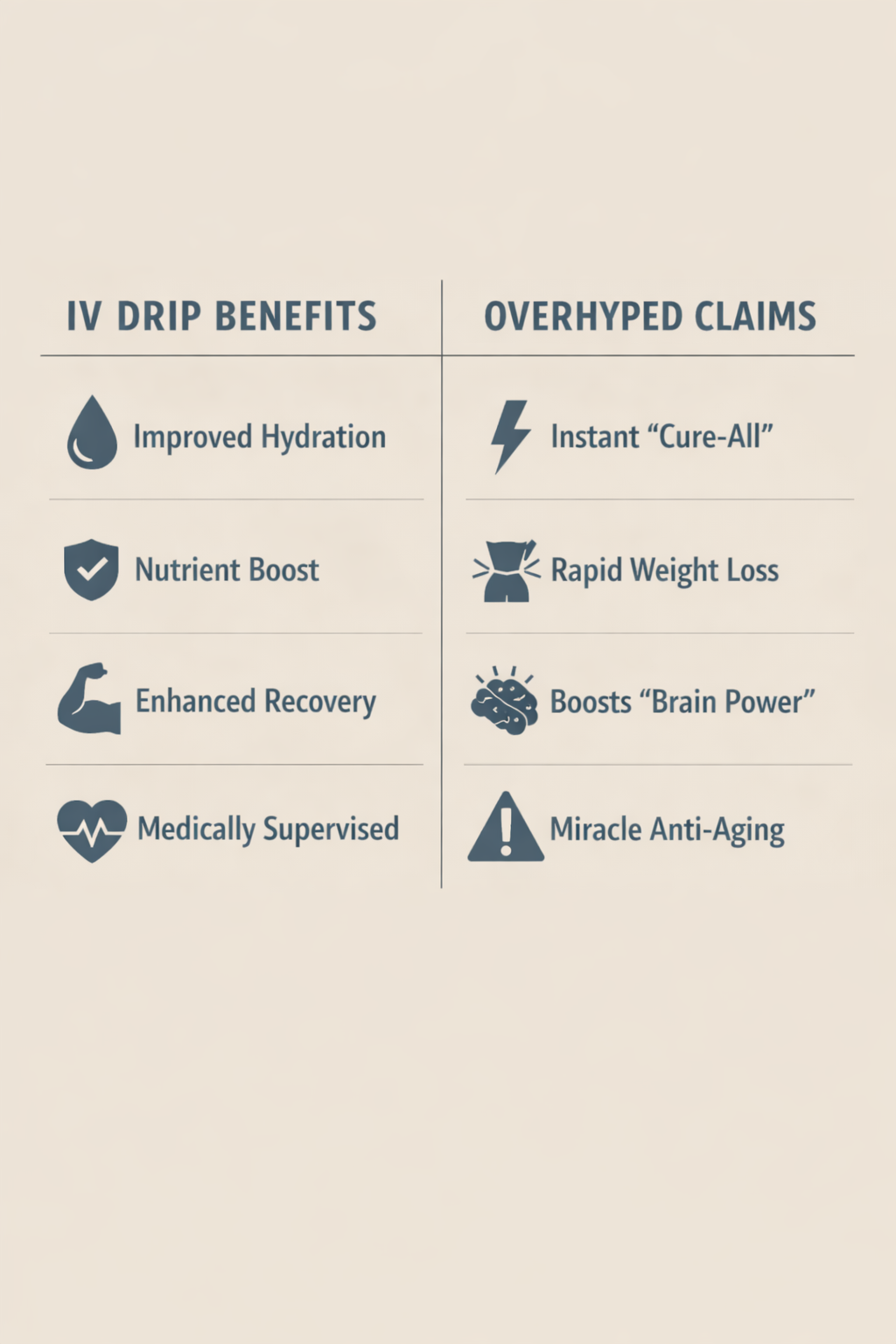
Marketing becomes weak when a drip is sold as a cure-all.
The US Federal Trade Commission took action against an IV cocktail marketer for unsupported claims that IV therapy could treat serious diseases including cancer, multiple sclerosis, and congestive heart failure.[5]
That enforcement action matters because it shows regulators are concerned about health claims that go beyond reliable evidence.
Be cautious with any clinic claiming vitamin drips can:
- cure disease
- replace medical diagnosis
- detox the body in a vague way
- guarantee immunity
- reverse ageing
- fix chronic fatigue without assessment
- deliver permanent skin transformation
Strong claims require strong evidence. If the claim sounds larger than the consultation process, pause before booking.
Benefits people may realistically notice
Some clients do report feeling better after an IV drip. That does not automatically mean the vitamins were the sole reason.
Possible reasons include:
- improved fluid intake after being under-hydrated
- rest during the appointment
- expectation effect
- correction of a specific short-term imbalance
- better recovery behaviors around the session
Realistic benefit language sounds like:
- temporary hydration support
- short-term recovery support in selected clients
- wellness support when clinically appropriate
- part of a broader plan, not a standalone fix
Unrealistic benefit language sounds like:
- instant total body reset
- guaranteed energy
- immune protection
- detox cure
- medical treatment without medical assessment
Risks and safety checks
IV drips are often presented as simple wellness treatments, but placing anything into a vein carries risk.
Potential risks include:
- bruising at the cannula site
- discomfort during insertion
- light-headedness
- infection risk if technique is poor
- fluid overload risk in unsuitable clients
- sensitivity or reaction to ingredients
Mayo Clinic Press warns that IV vitamin therapy has potential risks and may divert money and attention away from lifestyle measures with stronger evidence, such as nutrition, activity, stress management, and sleep.[4]
Safety screening should happen before treatment, not after a problem starts.
Who should be cautious before booking
You should not treat a drip menu like a smoothie menu.
Extra caution is needed if you have:
- kidney disease
- heart disease
- unstable blood pressure
- pregnancy or breastfeeding considerations
- active infection or acute illness
- a history of reactions to injected products
- unexplained fatigue that has not been medically assessed
- current medication interactions that need review
If symptoms are persistent, worsening, or unexplained, a medical evaluation should come before a wellness drip.
How to judge a good clinic
A stronger clinic will ask more questions before giving treatment.
Look for:
- medical history review
- medication and allergy screening
- clear explanation of ingredients
- realistic benefit language
- sterile cannulation process
- monitoring during treatment
- aftercare advice
- refusal to treat when unsuitable
Red flags include:
- no consultation
- pressure to buy packages
- disease-treatment claims
- vague "detox" promises
- no explanation of risks
- no named clinical accountability
Good IV therapy is assessment-led. Weak IV therapy is sales-led.
Benefits vs hype: the simple decision test
Before booking, ask four questions:
- What exact outcome am I trying to improve?
- Is there a simpler route, such as oral hydration, nutrition, sleep, or medical review?
- What evidence supports this drip for my specific goal?
- What would make us stop or change the plan?
If those answers are unclear, the treatment is not ready.
This is especially important for fatigue. Fatigue can come from sleep debt, stress, low iron, thyroid issues, infection, medication effects, mood changes, or many other causes. An IV drip should not be used to avoid finding the actual reason.
Vitamin drip FAQ
Are vitamin drips better than oral vitamins?
Not automatically. IV delivery bypasses digestion, but that does not mean every healthy person benefits more from IV use than from food, oral hydration, or indicated supplementation.
Can a vitamin drip cure fatigue?
No responsible clinic should promise that. Persistent fatigue needs proper assessment, especially if it is new, severe, or affecting daily function.
Do vitamin drips help dehydration?
IV fluids can be medically useful for severe dehydration or when oral fluid replacement is not enough, according to MedlinePlus.[1] For mild dehydration, oral fluids are often the first practical step unless a clinician advises otherwise.
Are vitamin drips safe?
They can be low-risk for suitable clients under proper clinical standards, but they are not risk-free. Cannulation, ingredient selection, and client suitability all matter.
Do drips boost immunity?
Broad immunity claims are often overstated. NIH Office of Dietary Supplements notes that evidence for vitamin C and disease prevention or treatment is mixed depending on the condition and context.[6]
Is feeling better proof that the drip worked?
Not by itself. A short-term improvement may reflect hydration, rest, expectation, or other behavior changes around the appointment.
How often should someone get a drip?
There is no universal interval. Repeat sessions should be based on assessment, response, and risk profile.
What should I ask before booking?
Ask what the drip is intended to support, what evidence backs that goal, what risks apply to you, and when treatment should be deferred.
Final take: useful for some, overhyped for many
The most accurate answer to do vitamin drips actually work is: They can work for specific, clinically appropriate goals, but many general wellness claims are stronger than the evidence.
If you want to book safely, focus less on the ingredient list and more on:
- assessment quality
- realistic expectations
- clinical monitoring
- aftercare
- review-led decisions
That is how you separate useful support from expensive hype.
Booking and next steps
If you are considering an IV vitamin drip, start with consultation and suitability screening.
- Explore treatment details: IV Vitamin Drip
- Compare booking options: Pricing
- Ask questions first: Contact Us
Sources and references
- MedlinePlus. Dehydration. https://medlineplus.gov/dehydration.html
- Mayo Clinic. Ascorbic acid (intravenous route). https://www.mayoclinic.org/en-US/drugs-supplements/ascorbic-acid-intravenous-route/description/drg-20406580
- Cleveland Clinic. Intravenous Vitamin Infusion Pros & Cons. https://health.clevelandclinic.org/iv-vitamin-therapy
- Mayo Clinic Press. IV Vitamin therapy: Understanding the lack of proven benefit and potential risks of this health fad. https://mcpress.mayoclinic.org/living-well/iv-vitamin-therapy-understanding-the-lack-of-proven-benefit-and-potential-risks-of-this-health-fad/
- Federal Trade Commission. FTC Brings First-ever Action Targeting "iV Cocktail" Therapy Marketer. https://www.ftc.gov/news-events/press-releases/2018/09/ftc-brings-first-ever-action-targeting-iv-cocktail-therapy
- NIH Office of Dietary Supplements. Vitamin C - Health Professional Fact Sheet. https://ods.od.nih.gov/factsheets/VitaminC-HealthProfessional/