

Do fat dissolving injections work? Honest results explained
If you are asking do fat dissolving injections work, the honest answer is: they can work for carefully selected pockets of fat, but they are often oversold.
The American Society of Plastic Surgeons explains that injection lipolysis uses deoxycholic acid to disrupt and destroy fat cells, and that nonsurgical candidates interested in reducing fat beneath the chin may consider this approach.[1] Cleveland Clinic also describes Kybella, a deoxycholic acid treatment, as a prescription injectable medication used to reduce submental fat under the chin.[2]
That does not mean every fat dissolving injection, every brand, every body area, or every client will get a dramatic result.

This guide explains what realistic results look like, what is hype, and how to make a safer decision before booking.
Table of contents
- Quick answer: do fat dissolving injections work?
- What fat dissolving injections are
- Where results are most realistic
- What fat dissolving injections cannot do
- Timeline: when results usually show
- Risks, side effects, and safety warnings
- Who is a better candidate
- Common reasons results disappoint
- Fat dissolving FAQ
- Booking and next steps
Quick answer: do fat dissolving injections work?
For the right person, in the right area, with the right product and clinical technique, fat dissolving injections can support localized contour refinement.
They are best understood as:
- a body contouring treatment
- a localized fat reduction option
- a gradual results pathway
- a treatment that needs proper assessment
They are not:
- a weight-loss treatment
- a replacement for nutrition or activity
- a fix for loose skin
- a guaranteed one-session transformation
- a treatment to copy from social media before-and-after photos
What fat dissolving injections are
Fat dissolving injections are designed to target localized fat cells through an injectable solution.
The best-known regulated example is deoxycholic acid for submental fullness. Deoxycholic acid occurs naturally in the body and helps break down dietary fat; the injected form is used to damage fat cells in a controlled treatment area.[2]
In aesthetic language, this is often called:
- injection lipolysis
- fat dissolving treatment
- chin fat dissolving
- non-surgical fat reduction
- body contouring injections
The treatment goal is contour improvement, not scale weight reduction.
Where results are most realistic
Results are usually more realistic when the concern is a small, defined pocket of fat.
Common planning examples include:
- under-chin fullness
- small localized body pockets
- stable areas that remain despite lifestyle consistency
- contour refinement where skin quality is still supportive
The under-chin area is the clearest evidence-backed area for FDA-approved deoxycholic acid treatment. The FDA warning page notes Kybella is FDA approved for reducing fat below the chin in adults.[3]
For other products or larger body areas, claims need more scrutiny because approval status, evidence quality, and product standards vary.
What fat dissolving injections cannot do
This is where many people get disappointed.
Fat dissolving injections do not reliably treat:
- generalized body fat
- significant weight gain
- visceral fat
- cellulite
- stretch marks
- loose skin
- muscle laxity
- large contour changes
If skin laxity is the main issue, fat reduction alone can make looseness more obvious. If the area is broad or poorly defined, the result may be too subtle to justify repeated sessions.
Good clinics should tell you when the treatment is not the best option.
Timeline: when results usually show
Results are gradual because the body needs time to process the treated fat cells and inflammation.
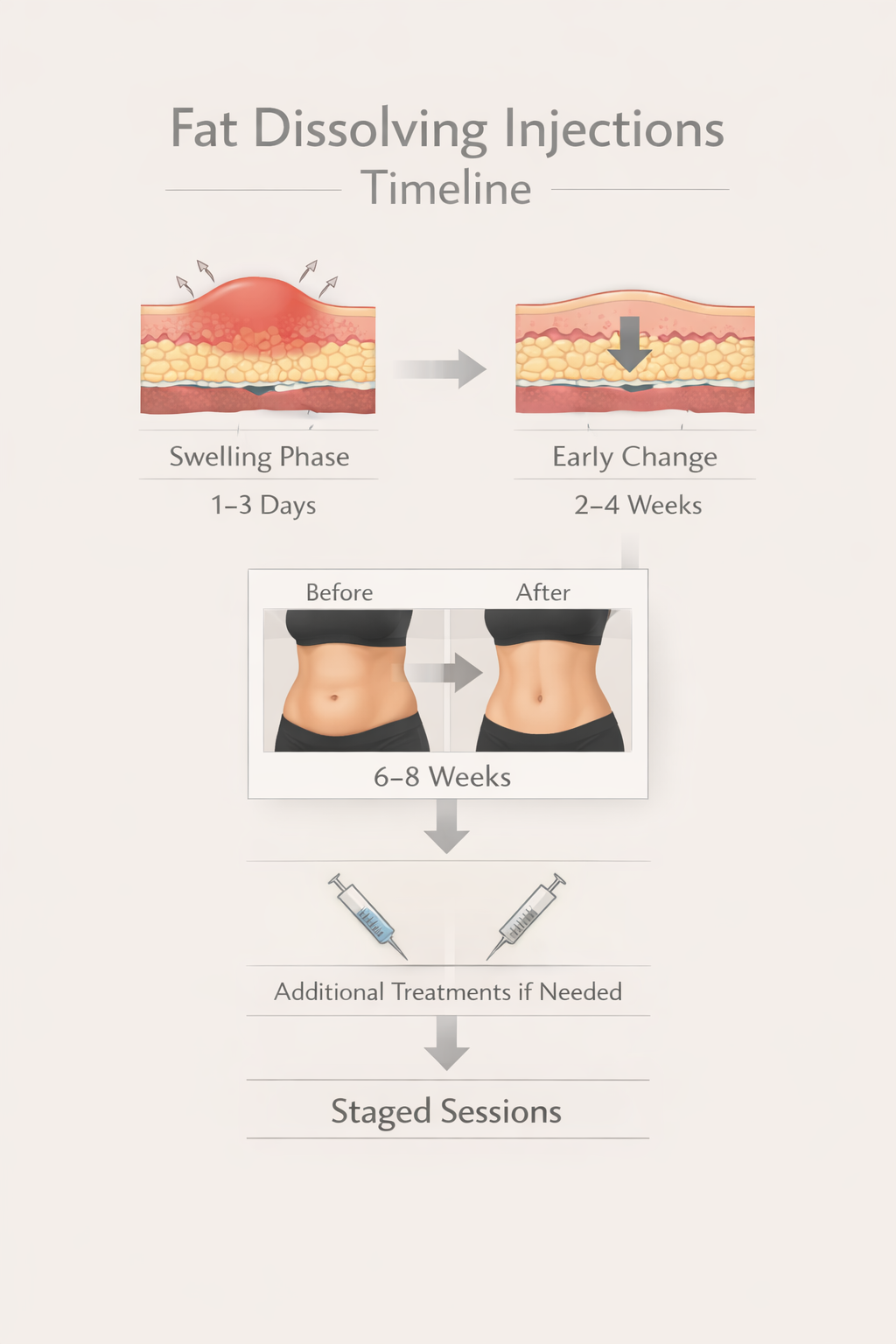
Typical pattern:
- first few days: swelling, tenderness, and firmness can be noticeable
- weeks 2-4: swelling starts settling and early contour change may become easier to judge
- weeks 6-8: clearer assessment window for many clients
- multiple sessions: may be needed depending on area and response
Cleveland Clinic notes that Kybella treatment may involve 10 to 30 injections per treatment depending on fullness, and a provider may recommend multiple treatment sessions.[2]
This is why judging results too early can lead to unnecessary anxiety or premature retreatment.
Risks, side effects, and safety warnings
Fat dissolving injections are medical treatments, not casual beauty add-ons.
Common short-term effects can include:
- swelling
- bruising
- tenderness
- numbness
- firmness
- redness
- discomfort at injection sites
Mayo Clinic lists injection-site effects for deoxycholic acid including bruising, burning, infection, inflammation, lumps, numbness, rash, scarring, soreness, swelling, tenderness, and warmth.[4]
The FDA also warns that non-FDA-approved fat dissolving injections may cause harm and that unsafe injection practices can increase risk of scarring, skin infections, and serious complications.[3]
This matters because many fat dissolving products are marketed online or used in settings where the client may not know the product status or injector training.
Who is a better candidate
A better candidate usually has:
- stable weight
- a defined localized fat pocket
- good enough skin quality to contract around the new contour
- realistic expectations
- willingness to wait for gradual results
- no relevant contraindications
A weaker candidate may have:
- diffuse fullness
- significant loose skin
- unstable weight
- unrealistic event deadlines
- strong expectation of dramatic transformation
- untreated medical concerns affecting swelling or healing
The most important part of treatment is not the injection itself. It is deciding whether the injection should happen at all.
Common reasons results disappoint
The concern was not fat
Some fullness is caused by skin laxity, posture, swelling, anatomy, or muscle structure. If the diagnosis is wrong, the treatment will underperform.
The target area was too large
Fat dissolving injections are better for refinement than major reshaping. Large areas often need a different strategy.
Expectations were copied from social media
Before-and-after posts rarely show full lighting, angle, session count, swelling stage, weight stability, or product details.
Treatment was repeated too quickly
Repeating before swelling and tissue response settle can confuse the result and increase irritation.
The product or provider was not appropriate
The FDA specifically warns about unapproved products and unsafe injection practices.[3] Provider choice is part of the treatment outcome.
Honest results: what good outcomes look like
A good result is usually:
- subtle but visible contour refinement
- better definition in a localized area
- improved fit between the target area and surrounding shape
- gradual rather than instant
- proportional rather than dramatic
For under-chin treatment, this may look like a cleaner jawline transition or reduced fullness under the chin.
For body areas, it may look like softened pockets rather than a transformed silhouette.
If you want large-volume reduction, surgery or other body contouring strategies may be more appropriate to discuss with a qualified professional.
Fat dissolving FAQ
Do fat dissolving injections work after one session?
Sometimes, but many clients need more than one session for a visible result. Session count depends on area, baseline fullness, product, and response.
Are fat dissolving injections permanent?
Destroyed fat cells do not behave like untreated cells, but weight gain can still affect remaining fat cells and overall shape. Weight stability remains important.
Do they hurt?
Discomfort varies. Common sensations include stinging, tenderness, swelling, and tightness after treatment.
Are they good for belly fat?
Only in carefully selected localized pockets. They are not suitable for generalized abdominal fat or visceral fat.
Are they good for double chin?
The under-chin area is the best-known indication for FDA-approved deoxycholic acid treatment in adults.[3] Suitability still depends on whether the fullness is actually fat rather than loose skin or anatomy.
Can fat dissolving tighten skin?
Not reliably. If loose skin is the main concern, fat dissolving may not be the right first choice.
Are non-approved products risky?
Yes. The FDA warns that non-FDA-approved fat dissolving injections and unsafe injection practices can be harmful.[3]
How do I know if I am suitable?
You need a consultation that assesses tissue type, skin quality, area definition, medical history, and realistic endpoint.
Pre-booking checklist
Before booking, confirm:
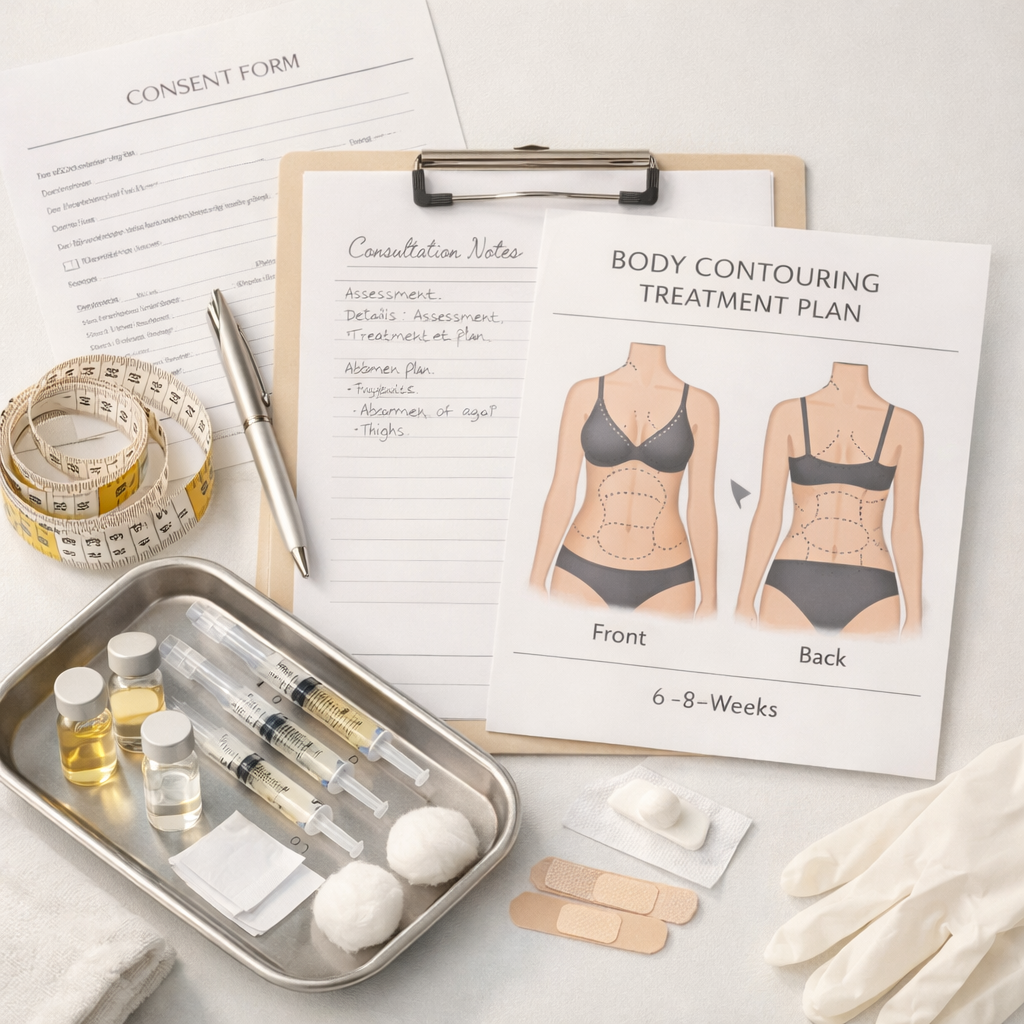
- the area is a defined fat pocket
- you understand this is contouring, not weight loss
- the product and provider standards are clear
- swelling and downtime have been explained
- the review interval is set before retreatment
- the clinic can say no if treatment is unsuitable
If the consultation does not cover these points, the treatment pathway is too weak.
Final take: yes, but only in the right case
The honest answer to do fat dissolving injections work is yes, they can, but only when the indication is strong and the expectation is realistic.
They are most useful for localized fat refinement. They are weakest when used as a shortcut for weight loss, loose skin, or broad body reshaping.
For best results, prioritize:
- correct diagnosis of the concern
- qualified clinical delivery
- realistic session planning
- product transparency
- review-led decisions
That is how you separate a worthwhile contouring treatment from expensive hype.
Booking and next steps
If you are considering fat dissolving injections, start with assessment so your area, skin quality, and expectations can be reviewed properly.
- Explore treatment options: Body Sculpting
- Compare pricing: Pricing
- Ask the clinic team: Contact Us
Sources and references
- American Society of Plastic Surgeons. Injection Lipolysis. https://www.plasticsurgery.org/cosmetic-procedures/nonsurgical-fat-reduction/injection-lipolysis
- Cleveland Clinic. Kybella Cosmetic Injection. https://my.clevelandclinic.org/cosmetic-plastic-surgery/procedures/kybella
- FDA. Using Fat-Dissolving Injections That Are Not FDA Approved Can Be Harmful. https://www.fda.gov/drugs/buying-using-medicine-safely/using-fat-dissolving-injections-are-not-fda-approved-can-be-harmful
- Mayo Clinic. Deoxycholic acid (subcutaneous route). https://www.mayoclinic.org/drugs-supplements/deoxycholic-acid-subcutaneous-route/description/drg-20146765